
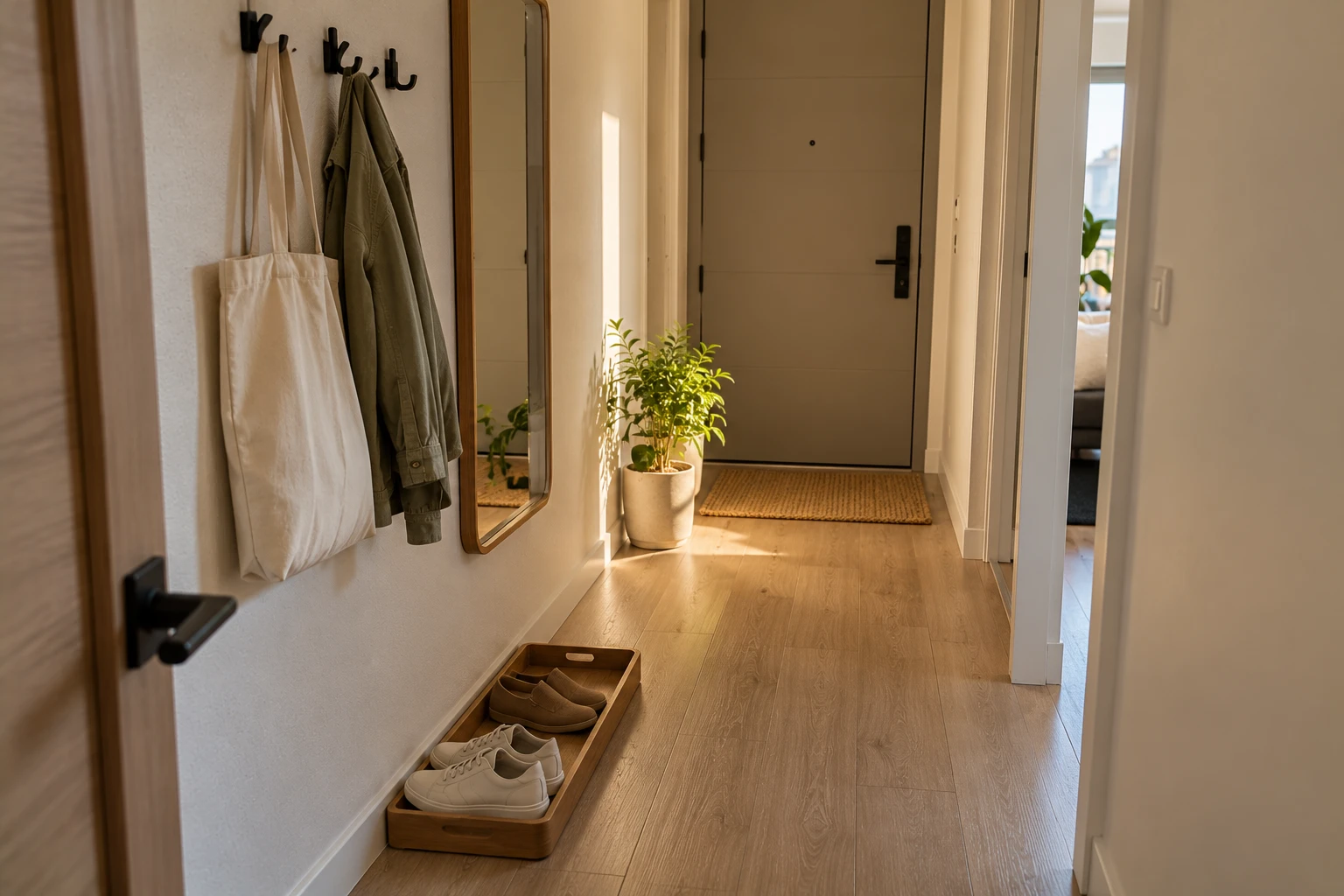
A console table is the default advice for entryways, and in a narrow hall it’s often the problem. These narrow entryway ideas skip the table entirely. They use the wall, the floor right by the door and storage you already have, so you can walk in with bags without turning sideways. Start with what you actually carry through the door each day and build around that.
Honestly, a few good hooks, one key spot and a shoe limit do more than any furniture can in a tight entry.
This article contains affiliate links. As an Amazon Associate I earn from qualifying purchases.
Measure the entry before adding anything
Write down three measurements before you shop:
- The door swing: how far the open door reaches into the hall. Nothing should sit inside that arc.
- The walkway width: about 36 inches (90 cm) of clear space feels comfortable for walking in with bags; even narrower halls work better when the floor is completely clear.
- Usable wall space: the side wall you can reach from just inside the door, outside the swing, is the most valuable spot in the entry.
Anything that sticks out from the wall, such as a shelf, a hook with a full bag or a basket, eats into the walkway. Measure how far it projects when it’s loaded, not when it’s empty.
1. Give everyday bags a place on the wall
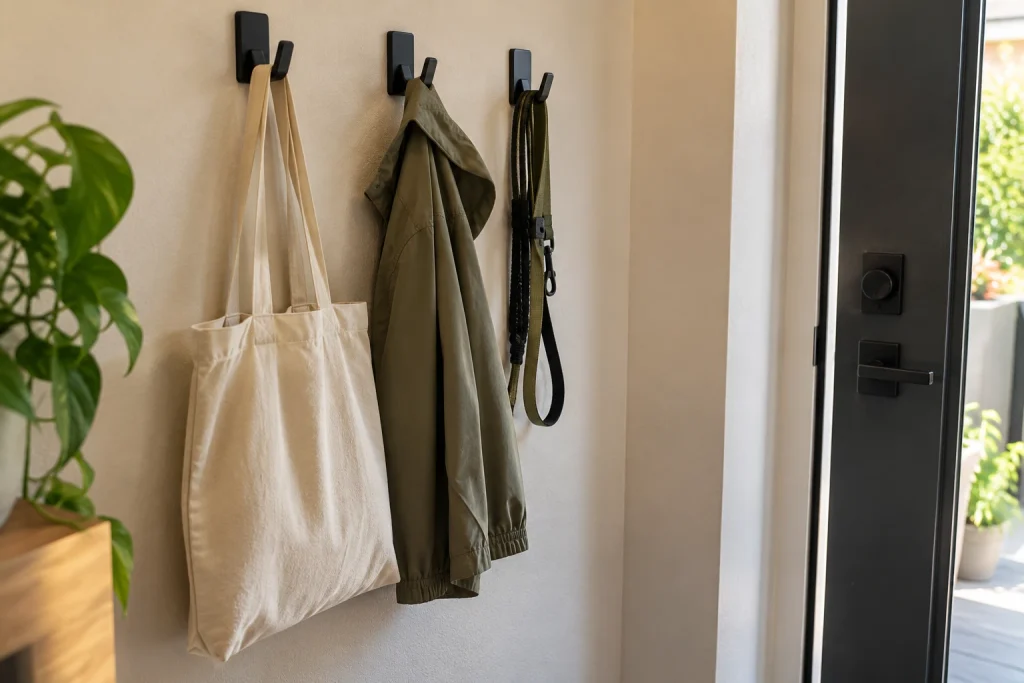
If you rent, adhesive hooks are the easiest place to start. For lightweight items on a smooth, compatible indoor wall, Command matte black double hooks (paid link) are a tidy choice, and matte black looks far less temporary than white plastic. Check the weight of the filled bag against the current package limit and surface instructions. A hook that holds an empty tote may not hold it with a laptop and water bottle inside.
Choose the position by acting out your arrival. Open the door, step inside and notice where your hand naturally reaches. As a starting point:
| Item | Typical hook height |
|---|---|
| Adult bags and jackets | About 60–66 inches (150–170 cm) from the floor |
| Children’s bags | About 36–48 inches (90–120 cm), adjusted to their reach |
| Dog leash, reusable shopping bags | A lower hook near the door frame |
Leave about 8–10 inches (20–25 cm) between hooks so bags don’t pile on top of each other. Give each person one or two hooks rather than a long row; otherwise one person slowly claims every hook. Hang only the items that would otherwise land on the floor and keep the rest in a closet.
Adhesive hooks have limits. Follow the brand’s directions for preparing the surface, waiting before loading and removing. Check your lease and avoid textured or freshly painted walls. If your walls aren’t compatible, use screwed-in hooks with permission or closet storage instead of trying a stronger adhesive.
2. Create a key drop inside something you already own
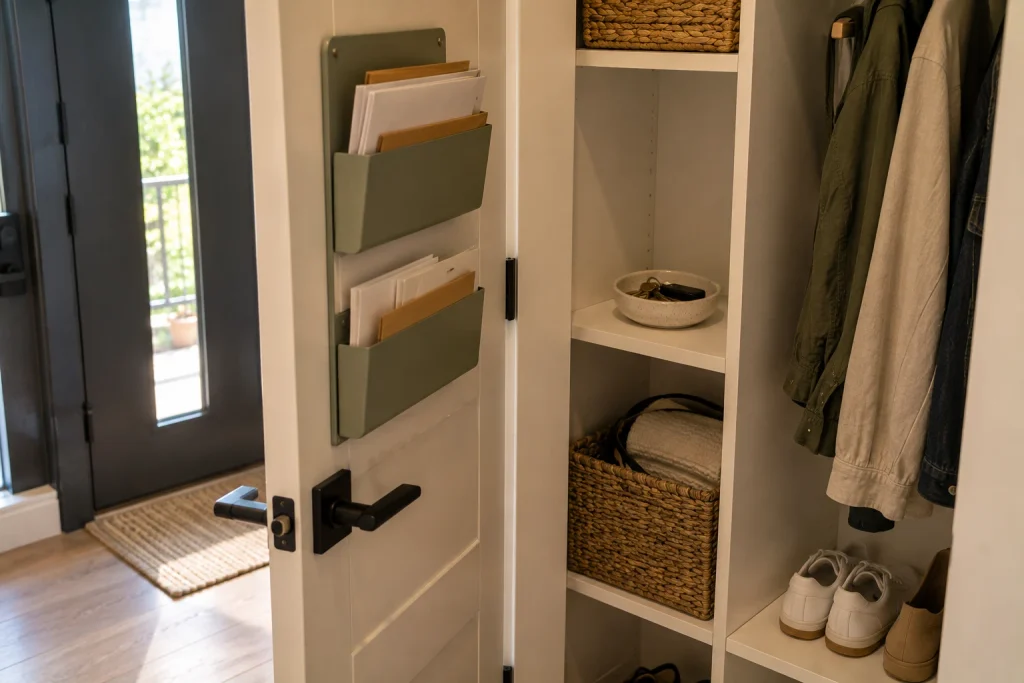
An entry without a table still needs a dependable spot for keys. Look at the nearest existing storage first: a shallow dish on a closet shelf at chest height, a small box in a nearby cabinet or a pouch hanging from one of your hooks. Keep it within a step of the door so you use it without thinking.
Keep keys separate from mail. Paper piles up fast and a key dish soon becomes a sorting tray. A slim wall file inside a closet door, or a tray you empty at a desk each evening, keeps envelopes moving.
If a small wall shelf is your only option, choose one no deeper than about 5 inches (13 cm) and measure its full projection, including brackets and anything sitting on it. Try your key spot for a few days with a container you already have. If your keys still end up somewhere else, move the container to where they land. Good small entryway organization follows your routine before it asks you to change it.
On a dry shelf, an air dry clay trinket dish makes a small, personal key container. Keep it away from damp shoes and splashes.
3. Limit shoe storage to the pairs in rotation
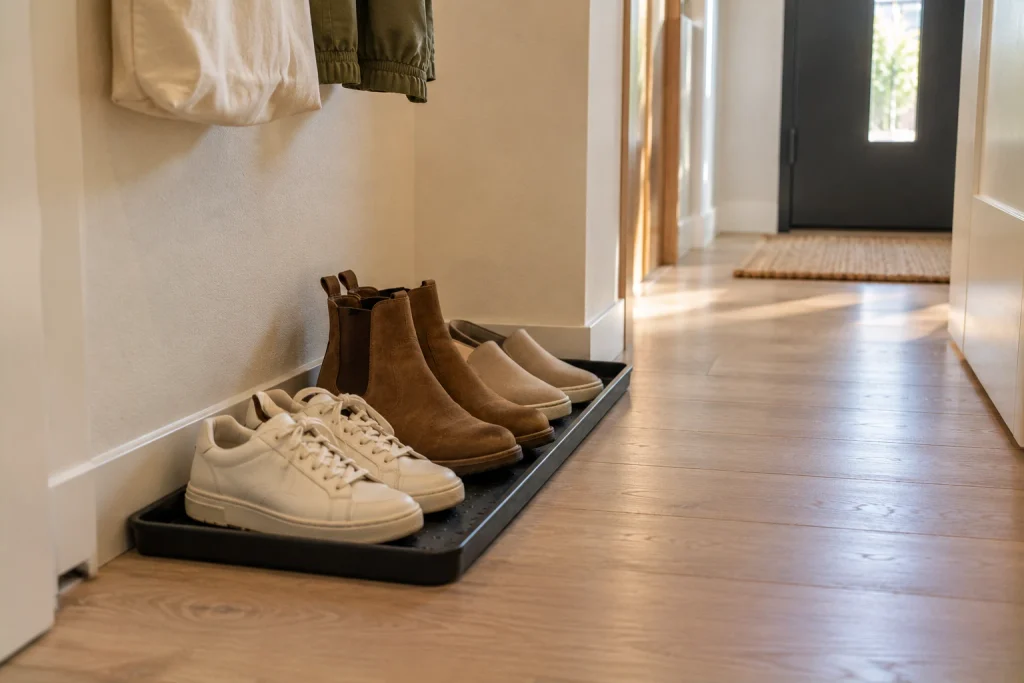
This is the idea I’d push hardest. Count the shoes left by the door after a normal week. Separate pairs you wear almost every day from occasional shoes that can live in a closet. Your narrow hallway doesn’t need to hold your whole collection.
- Set a limit: one or two active pairs per person is a realistic starting point for most narrow entries.
- Use a low, wipeable tray: a boot tray around 14 x 30 inches (35 x 75 cm) holds three or four pairs and catches water and grit.
- Test the door with shoes in place, not just the empty tray. Tall boots can catch a door that cleared the tray during setup.
- Rotate: when a new pair joins the tray, the least-worn pair goes to the closet.
In a very tight entrance, a shelf inside the nearest closet is better than a permanent obstacle in the path. Let wet shoes dry on the tray before putting them in enclosed storage. A woven basket looks nice but is harder to clean than a simple rubber or plastic tray.
4. Use one mirror to make the entrance feel intentional
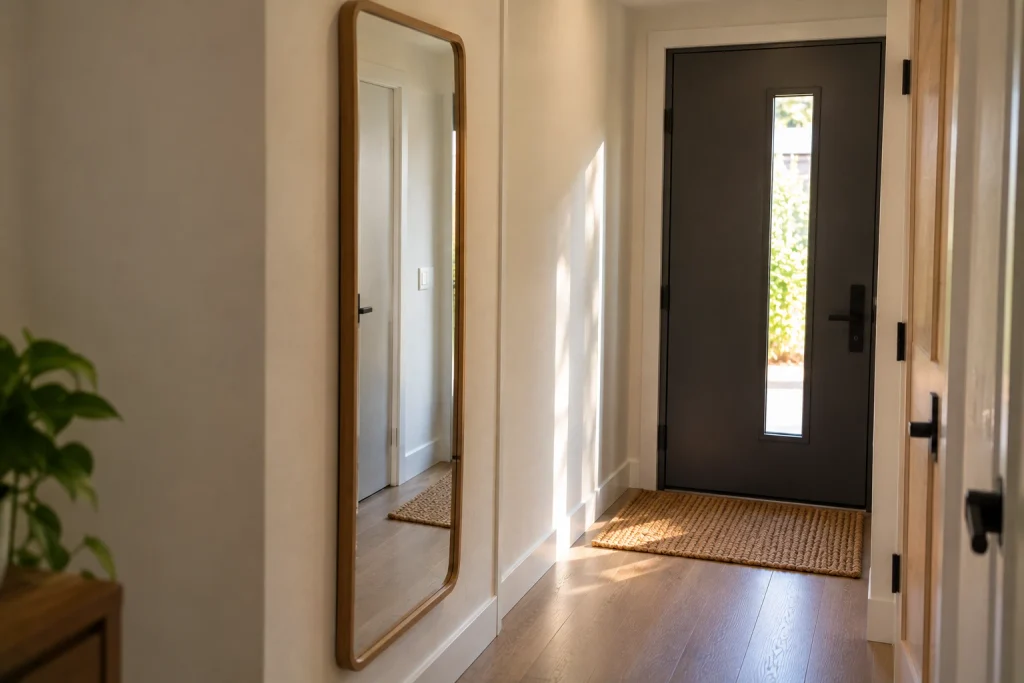
A mirror gives the entry a finishing point without adding a tabletop, and it’s handy for a last check before leaving. Choose its spot after you’ve decided where bags and shoes go, so it doesn’t take the only wall that could hold hooks.
Look at the reflection from the front door. A mirror facing a tidy wall or a brighter room makes a nicer first impression than one reflecting a crowded coat hook. A slim vertical mirror suits a short wall beside the door; a smaller round one can sit above a shallow key shelf. Hanging the center around 57–60 inches (145–150 cm) from the floor puts it near eye level for most adults.
Use hanging hardware rated for the mirror’s weight and your wall type, and follow the mirror’s instructions. Don’t assume the adhesive hooks that hold a tote can hold glass. Skip extra frames crowded around the mirror if they make the wall busy.
5. Connect the entrance to the room beyond it
Repeat one detail from the next room to make the entry feel connected: black hooks with nearby black picture frames, a wood mirror with a wooden bookcase, or a mat in a color already used in the living room. Keep the palette simple, since coats and bags already bring plenty of color.
If you use an entry mat, choose one flat enough for the door to clear and with a nonslip backing suitable for your floor. Avoid layered rugs or curled edges in a tight passage. Light matters too: if the hallway is gloomy, a brighter bulb in the existing fixture (within its rated wattage) helps you see the floor and find your things.
Test it with a busy arrival
Finish by walking in with a full grocery bag in each hand. Can the door open fully? Can another person pass? Can you hang your bag and drop your keys without setting everything on the floor? Move or remove anything that makes that test awkward. A plain entry that works beats a styled one you have to squeeze past.
If the entrance opens straight into your living space, these small living room arrangement ideas help you keep the shared walkway clear.